Précis
Anno domini 1646
England is ravaged by four years of bloody civil war. Hunger haunts a barren land where farmers have abandoned untilled fields to take up swords, pikes and muskets. Widows mourn their husbands whose children will have no father. The silent gravestones of the fallen do not declare if the dead beneath were Royalist or Parliamentarian, Cavalier or Roundhead.
England’s King Charles, in the twenty-first year of his reign, sits not on a throne in Westminster Abbey but on a common chair in Anderson Place in Newcastle upon Tyne. He is prisoner of the Scottish Covenanter army under General Leslie, Earl of Leven. He tries to bargain for his release. Parliament has just passed an ordinance to abolish archbishops and bishops within the kingdoms of England and Wales. No bishops, no king.
The future of England as a kingdom, ruled by a royal family, rests tenuously upon a small band of exiles in France. In Paris, Charles’s queen, Henrietta Maria, has a Court of English leaders who have no plan to recapture their homeland. She has made herself comfortable in the France where she grew up as a daughter of King Henry IV. Her brother, King Louis XIII, recently died, leaving her eight-year-old nephew, Louis XIV, as nominal head of state. His Spanish mother, Anne of Austria, is an unpopular regent and rules through her cunning Italian principal minister, Cardinal Mazarin. Another brother of Henrietta Maria is Gaston, Duke of Orléans, known by all as Monsieur; he is a perpetual schemer. Twice the mercurial Gaston has fled into exile for plots to overthrow his brother and his minister, Cardinal Richelieu. Many believe that Monsieur, Gaston, is a threat to his young nephew and to Richelieu’s successor, Mazarin.
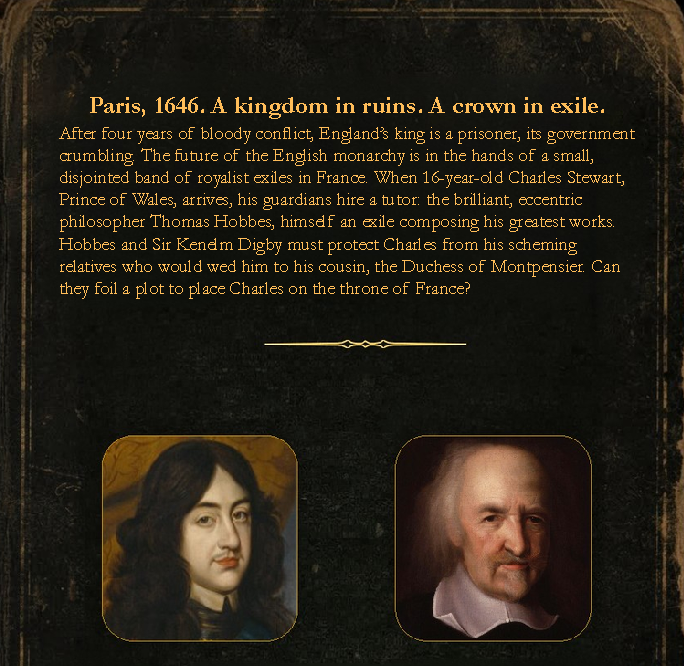
Recently arrived in the French capital is Henrietta Maria’s eldest son, Charles, Prince of Wales. At sixteen, he is tall, handsome, and precocious. At his father’s side, he observed at first hand the savage fighting against the continued rule of the Stewart family. Like his cousin King Louis XIV, he is a grandson of the great Henry IV. Four of his siblings, two brothers and two sisters -- Henrietta Maria’s other children -- are held hostage in St James's Palace, London, under the guardianship of the Earl of Northumberland. Henrietta Maria can be forgiven if she longs for her son to kneel beside her at a Catholic Mass at Notre Dame. It is perfectly understandable if she wishes to see him matched with his cousin, the beautiful and wealthy daughter of Gaston, Anne Marie, the Duchess of Montpensier. She may never again see her husband and those four other children, but she would welcome the loving comfort of grandchildren who shared a great-grandfather in Henry IV.
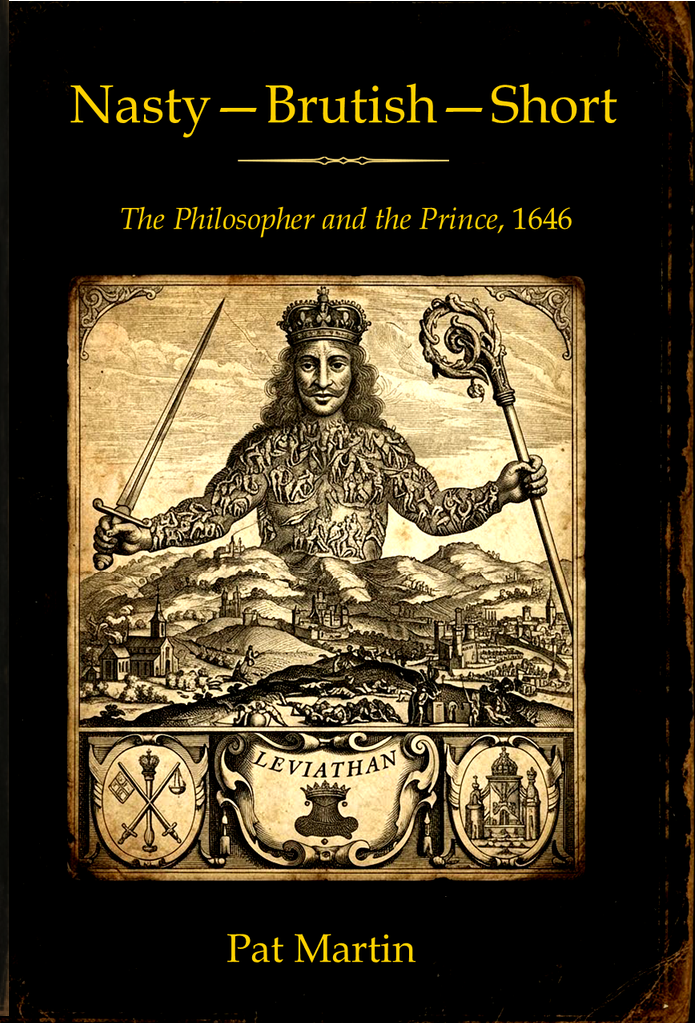
Some of the English exiles are alarmed that the presumptive heir to the English throne might become Catholic and so wed to France that he would prefer permanent residence in Paris. They have separated Charles from the direct influence of his mother by setting him up at the royal palace of St. Germain-en-Laye with his closest friends, twenty kilometers from her Court in the Louvre. Because of the rebellion, Charles has not completed his education. To occupy his time and prepare him for kingship, the leaders among the exiles employ tutors to teach Charles. The most able of these is well known in England and on the Continent as a mathematician, a scientist, and a philosopher, Thomas Hobbes. Hobbes promised he would confine his lessons to geometry. But could a scholar who had served the Lord Chancellor of England, Francis Bacon, after his impeachment by the Parliament men now in rebellion resist the opportunity to guide a future king on the meaning of kingship? Even as he tutors, Hobbes works daily on his greatest work, his Leviathan.
What follows could have happened. . . .